Pages

Wednesday, 20 April 2022

Writing Diary: April


You must have a social media presence. Publishers expect it, readers expect it.

So they say.

But what exactly is it for?

It is so you get noticed? Who is going to notice you on Twitter or Instagram unless you find yourself a niche as the amusing dog-owner or the person who always posts pictures of fabulous libraries? Does anyone actually want to know what I think about anything? Do I want them to know? Can I be bothered to figure out what Tiktok is and whether it would be any use to me?

Is it so people can find out about you? I suppose… I’ve heard people swear they’ve got writing or editing jobs through Twitter or LinkedIn but I find it hard to imagine how that comes about.

But nonetheless, everyone tells you it's necessary. All the writers I know use social media in some form or another. Most have a website. As for me, I blog reasonably regularly. I try to stick to things I think might be useful to other writers or things that I think are interesting about my work. I share my blogs on social media and a handful of people read them, some of them my family. I use Instagram, mostly to share whatever I’m reading and sometimes things I see on my walks. Facebook is for what I’m reading. I don’t really know what to do with LinkedIn but I’m on there too.

The thing that’s been nagging at me for a long time now is a website. It seemed complicated and possibly expensive. What would I put on it? What would people want to know? Who would search for me? I looked at a lot of other writers’ websites. Hmm. I could do this. A lot of the pages weren’t that different from this blog.

Some pictures.
A list of everything I’ve done.
A link to this blog.
A list of workshops and events I could provide.
A contact page.

I started to play around.

And then I stopped. The free trial was over. Was I going for this – in which case please pay – or was I just going to let it drop (again)?

And then, right then, you know what happened?

I did an event through a friend of a friend and someone said to me, “I searched for you on the internet but I couldn’t find you.” Well, they hadn’t looked very hard. I have a very common name, it’s true, but if you google me my Twitter account comes up on the first page and if you look up ‘Claire Watts writer’ pretty much the whole page is me. So presumably that means I am doing something right.

However.

What this person actually wanted to find wasn’t they little bits and pieces you find on Goodreads or my Amazon author page. They didn’t want to read what I’d said on Twitter or look at what I’d been reading on Instagram. They wanted a website dedicated to information all about me.

So I paid the money and published the website. I have no idea how to get the website onto that first search page, but it’s easily findable through all my other socials. Perhaps someone will find it and give me some work or book an event. Or perhaps someone will just decide to look me up and find out more about me.

Have a look. You'll find it here: https://www.clairejwatts.com
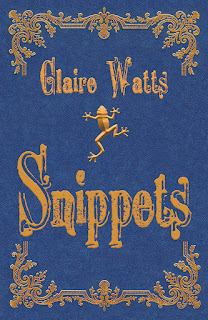


My new book, Snippets, is available now.
You can read a Snippets story that's not in the book here

You can get a copy of Snippets on Amazon Or if you’d like a signed copy send me a message on Twitter, Instagram or Facebook

Go to https://ko-fi.com/clairewatts to read a new Snippets story every month. It’s free, but you can support me with a donation if you like.

Friday, 25 March 2022

Writing Diary: March


When I last wrote this diary, I’d just got to the end of the first draft of my new book. Finishing that draft coincided with my getting something else I’d written back from my agent with lots of things to do and think about, which turned out to be perfect timing. The thing about first drafts is that you really need to write them and then turn your back on them. ‘Drawer time’ some writers call this. What it means is that you get your mind completely free of it, so that when you come back to it, you view it with fresh eyes. You can see what’s great, what’s less than great, where there are holes and inconsistencies. Drawer time is an essential part of the creative process and having something else to immerse your creative self in totally during that time is a perfect way to unshackle yourself from the draft in the drawer.


Did I throw myself into working on the book my agent sent back to me straightaway? No I did not. I griped and complained to myself about what they thought needed to be done to it. I asked writer friends for their opinions about the comments. I asked my agent for clarification on some points. I resisted and resisted. These changes were IMPOSSIBLE! They’d make the story into something else entirely! It wouldn’t be my story anymore. I reread the book from beginning to end. I calmed down a bit. I thought about it for a few days, a week. I did all the other things on my to-do list.


Then I started with the changes that made sense to me, the ones that were easy to do and wouldn’t have a knock-on effect elsewhere in the book.


Then I spent a good bit of time on the beginning. The first 5,000 words are key. Many of the people who are going to be involved in buying and marketing your book will never read beyond those first 5,000 words, so they’d better be hooky as hell. Mine needed more tension, more threat. I tend towards subtle, which has its place, but maybe not in these first 5,000 words.


I came to the big problem, the thing that according to my agent and their industry reader knocks my book from realistic YA speculative fiction into sci-fi: the inclusion of teleporting. My feeling is that it’s such a minor element in the book that it can't change the nature of the book. The way people travel is very important to the world-building and in this particular context, I needed something as near instantaneous as possible. But could I have almost instantaneous travel in a ‘realistic’ way? I just couldn't see it. So I wrote a list of possible ways to doing this by advancing technologies we have now. I came up with a solution. It’s not as elegant as teleporting and I’d argue that it still seems a bit sci-fi, partly because I had to give more explanation of how it works, whereas with teleporting, well, everyone knows how that ‘works’.


More reading, more tweaking. Another beginning to end read-like-a-reader read. And now the book's with a couple of useful readers for comments before I finalise the changes and send it back to my agent to see what they think.


Which means it’s time to open the drawer and take out that first draft again. I’ve read it through. There’s everything I expected: parts that work and parts that don’t, a big hole where I somehow missed out a scene that was on my plan, some overlaps because I wrote out of sequence. But, you know, it’s a great story. The beginning and end are in the right place. All the people are there. I can see where I need to build on it. Drawer time, folks – it’s invaluable.


My new book, Snippets, is available now. 

 You can read a Snippets story that's not in the book here


You can get a copy of Snippets on Amazon http://authl.it/c5p?d 
Or if you’d like a signed copy send me a message on Twitter, Instagram or Facebook.

Go to https://ko-fi.com/clairewatts to read a new Snippets story every month. 
It’s free, but you can support me with a donation if you like.

Friday, 11 March 2022

Tiny pieces of fairy tale

I’ve got a new book out. Snippets is a book of 22 very short stories that look into the spaces left for the reader or listener’s imagination in traditional fairy tales. They’re moments that delve into character or sensation or motivation. Sometimes they follow the letter of the traditional story and sometimes they ask questions about it or provide answers to questions that lurk beneath the surface.


How Snippets came to be

A few years ago I set myself a 500-words-a-day writing challenge. 500 words a day is a pretty easy challenge most of the time. It’s about half an hour’s writing time for me. The trouble is, sometimes you’ve got to a point in your work-in-progress where you don’t want to be adding 500 words a day to it. And sometimes the day gets away from you and it’s ten thirty at night and you still haven’t written your 500 words. I started doing writing exercises from books but they weren’t exactly what I wanted. So instead I wrote down a whole lot of things I thought I would like to practise writing – jealousy or tension or fear or the antagonist’s point of view. Every time I was stuck for what to write for my 500 words I picked something from the list and I picked a fairy tale character and I started to write. Soon I found I wasn’t looking at the list at all. And I was writing the stories every day. Often a new idea would come to me as I was waking up and I’d grab my laptop and sit up in bed typing.


My first encounters with fairy tales

I have always loved fairy tales. When I was growing up I didn’t own a lot of books. My mother is a library-goer, so we went to the library every week and had the glory of choosing four books from the library shelves. We moved around quite a bit, but whatever new library we went to, there was a shelf of fairy tales and myths and legends right next to the children’s section. I know now that fairy tales are next to children’s books in the Dewey Decimal System, but at the time what it meant to me was that the fairy tales were special. On each visit I would take three novels and a book of fairy tales. Library-lovers of my age would recognise those fairy tale books: Ruth Manning Sanders Books of Princesses and Trolls and Wizards, illustrated by Robin Jacques, and the ones called ‘Favourite Fairy Tales told in …[some country]. There seemed to be an endless supply. At home, I had a collection of Ladybird fairy tales, sadly long since sold to a second-hand bookshop to feed my appetite for new stories. I had an LP of a dramatised Cinderella to play on our radiogram – it was something like a pantomime with Buttons and comedy Ugly Sisters and some very cheesy songs. I also had a 45 with a fabulous version of Sleeping Beauty, with music from the ballet and a terrifying wicked fairy, Carabosse, with a ‘retinue of rats’!


Why fairy tales appeal to me as a writer

There’s a world of fascinating, erudite study of fairy tales that I’ve scarcely scratched the surface of. For me, fairy tales are the essence of story. You may have seen some of Jan Pienkowski fairy tale illustrations about the place since his recent death (if not, go and look him up). These black silhouettes of characters moving across coloured backgrounds are, for me, what fairy tales are like. Fairy tale characters are puppets, who either have no names at all or else have generic names like Jack or Ivan or Gretel that appear again and again, or symbolic names like Cinderella or Little Red Riding Hood or Beauty. Fairy tale plots may be full of incident, but the essential through-line of the plot is straightforward – they’re about seeking your fortune, coming up against an enemy, finding a husband or a wife. The teller can do anything with these stories, that’s the point. That’s why they endure and why they reappear again and again in different forms. They’re different from myths and legends because those are anchored to real places or specific characters like King Arthur or Cucullin. I’ve always considered them different from authored fairy tales like Hans Andersen’s or Oscar Wilde’s because there’s no room in those stories for anything beyond what the author has told you (unless you change the ending totally and make a weird uncomfortable mess like Disney’s Little Mermaid). Having said that, I’ve read that even some of those I think of as authorless aren’t really. No matter, for me fairy tales are made for retelling, they’re made for the teller to make them their own, to act out the parts, to do the voices for the three bears or threaten the pigs “I’ll huff and I’ll puff.” They’re made for storytellers to pick apart and weave into new stories that have a satisfying familiarity about them. They’re made for me to sew my own tales into.


 You can read a Snippets story that's not in the book here


You can get a copy of Snippets on Amazon http://authl.it/c5p?d 
Or if you’d like a signed copy send me a message on Twitter, Instagram or Facebook.

Go to https://ko-fi.com/clairewatts to read a new Snippets story every month. 
It’s free, but you can support me with a donation if you like.

Friday, 11 February 2022

Writing Diary: February


I started working on a new book on January 4th, with the aim of writing a thousand words a day five days a week until I was finished with the first draft. I had expected this to take me until near the end of March but I discover to my surprise that this first draft is coming out much shorter and I’ll be done with the initial writing by the end of this week. On reflection, I’m not sure why I ‘m surprised; I’d divided the plan into scenes and I’ve written one scene of a thousand words or more each day. True, I’ve added in a couple of extra scenes along the way, but basically I’ve run out of scenes.


Even though I’m finished putting words on paper for this first draft I haven’t actually finished with it to the point that I’m ready to set it to one side. This one is far too scruffy for that stage. I like to play around with different working methods. The act of putting a first draft into big blocks of words on a screen can be extraordinarily tedious. Some of it sings at once, of course, but for other bits you’re simply working out how to move your characters from A to B or what they should be doing to break up their conversations. I find that varying the method I use to write means I’m not completely comfortable with the writing and that keeps it from being dull (mostly).


This time my new method was to write by hand first and to write out of sequence. Before the start of each week I’d write a list of the five numbered scenes that I was going to write that week, picking them randomly from my detailed plan. Then each morning I’d get out of bed, check the plan and write for an hour. That was usually long enough to write a scene. I generally write in pencil but I decided to use one of the fountain pens I own and never use instead. I discover that writing with a fountain pen is extraordinarily pleasing. The nib floats across the paper.


After the hour of writing by hand, I’d get up and dressed, possibly run, and then sit down and type up what I’d written. But of course, I wasn’t typing word-for-word what I’d written at all. I was refining and reordering, adding in things I’d thought of as I ate my breakfast, smoothing out knots, occasionally checking facts. The typed-up scenes mostly fell at around 1,000 words. I suspect when I come back to look at them again I may find that some seem rushed and others stretched, but the aim was to get words on paper My idea was that by handwriting first and then typing up I’d get through two draft stages in one go and I think it’s worked.


When I’ve finished writing all the scenes at the end of this week it’ll be time to go back to the beginning and sort out the unevenness created by working piecemeal. I know there are places were one scene overlaps with another and there are probably gaps too. There are things I invented in later scenes that I’ll need to add in earlier. I suspect there’ll be plot holes because it’s quite a complicated plot and I know there’ll be places where I need to let my character have some fun with her situation and others where I need to scare her a bit more It’s a long way from being a finished first draft. But the hard bit, the big chunks of words on paper that tell a story, that’ll be there. The rest is much more fun.


My new book Snippets: Tiny Pieces of Fairy Tale is available now.

Sunday, 23 January 2022

Who are you writing for?


The audience for children’s books is complicated and I think it’s worth considering.


Yourself
When you write it’s important to please yourself first, to strive to create a story that satisfies all your wishes about stories. You will probably never be completely satisfied with your own story because that’s the way creativity goes, but the joy is that once you have got as near as you can, you get to start again, to get nearer.


Children
Of course, children. You need to tailor your book to your child audience. That means, on the whole, that your use of language is going to be more straightforward than it might be for an adult book. It means your story structure is likely to be simpler. It means that you cannot assume your reader has knowledge of things that are known to you as an adult. It’s vital to engage children quickly in your story – they have other things that demand their attention more insistently than books, and there are lots of other books to read that will satisfy their urge for funny or spooky or exciting or emotional right away. And, for me, ending with hope is non-negotiable in a children’s book. That doesn’t necessarily mean ‘happy ever after’, but there must be an element of positive closure. Oh, and closure itself is important: it’s cheating your child reader to end a book end without closing the central story so that they are obliged to seek out the next in the series (which may be a year away if this is a newly published book). Children are growing up – they want the whole story right now. Next year may be too late.


Audience vs purchaser

This is where the difference between children’s books and adult books lies. Children sometimes buy books for themselves. They sometimes select books to read from a library. But there’s a whole set of people who do most of the buying on their behalf or who advocate on behalf of books to children.


Parents, carers and gift-buyers
Parents and carers don’t necessarily know anything about the children’s books that are available. (Of course some do, but I’m thinking about the majority of parents and carers who, even if they are readers themselves, aren’t necessarily interested in children’s books.) They know about the books they enjoyed as a child. They recognise big name authors and celebrities. If a lot of children are reading a particular author or book, they may become aware of it. If a child is a reader or if they need or want a book by a particular author or for a particular reason, the parent or carer might consult a bookseller or librarian. Otherwise, they’re probably going to go for something they recognise or pick up something that looks appealing from the bookshop display tables. How do you, as a children’s book creator, grab these people’s attention? I don’t know.


Teachers
Primary school teachers want children to read books and they want books that children will listen to and understand and find engaging. Some teachers are hungry for knowledge about new children’s books that will engage readers and listeners. They want to know about all sorts of books to fit all sorts of readers. For class reading books, they may like books with issues they can discuss or a relevance to the local area or full of beautiful language or ideas or extraordinary flights of imagination. They may want funny or thrilling stories to capture the children who are not yet sold on the idea of the book as entertainment. They like books that come with free resources that are useful in their classrooms.

In an ideal world, where primary teachers would have time to engage with the world of children’s books and with the reading needs of individual children, and would have access to funds to buy all the books they want and need, teachers would be the key to your child audience. But we have to face facts. Primary school teachers have enormous burdens on their time and mental energy. Books are just a small part of all the things they need to learn about themselves and engage children with. Budgets for school libraries are puny and irregular. A lot of school libraries only get new books when parents donate books their children have grown out of.


Librarians
Ah, librarians! These are the glorious champions of children’s books. It’s their job. A children’s librarian is on the lookout for books that will engage and excite children. They want all sorts of books in their library to suit all sorts of readers. They’re not just looking at the books that shout at them because of celebrity authors and zeitgeist; they’re looking at everything the publishing world produces. They have knowledge to share and they’re prepared to share it. But how many schools actually have a dedicated librarian? How many public libraries have a children’s librarian?


Book reviewers and bloggers
The space given to children’s book reviews in newspapers is hugely disproportionate to their position in the market. The reason for this, I presume, is that children are unlikely to be reading the newspaper. But that’s nonsense, of course, because on the whole children aren’t the ones buying books. *sigh* There are other places, children’s book magazines and review blogs. The writers of these are part of the audience for children’s books, but of course, they’re not who you’re writing for. But they are important, nonetheless. Engaged parents and teachers and librarians will use this source of information about children’s books. So even if you’re not writing for them, you need to be thinking about them when you start marketing your book.


Agents and Publishers
Are you writing for agents and publishers? Unless you're planning to self-publish, then you certainly ought to be thinking about them. It's the job of agents and publishers to think about the market for your book. Personally, I suggest leaving this bit to them. Don't write for them. Think about the book you want to write and write it, then do your best to put it in the hands of an agent or publisher who is likely to want it. You can find out what they're looking for on their websites, or sometimes on Twitter or blogs. Or look at other things they publish and decide if your book fits their list. 


What does all this mean? It means that you may be thinking about how your book will satisfy yourself and your child audience, but agents and publishers will consider your book in the light of the purchasers and champions who will get your book into the hands of children. Write what you want to write, but bear this in mind when it comes time to send your book out into the world.


My latest book, Snippets, is out now.

 You can support me and my work by buying me a coffee on Ko-fi.

Monday, 3 January 2022

Writing diary: January


Start of the year means resolutions, of course.


I love a resolution. Part of it is a result of being self-employed, and at the moment entirely in control of my own workload (due to no one breathing down my neck demanding I get on with producing timeless prose). Part of it is just my nature, I think. I like a schedule. I like targets. I like to keep a timesheet so I can be accountable to myself for what I’ve been doing with my time.


In fact 2022’s resolution is a direct result of 2021’s timesheet. As well as logging the hours I spend on various projects and tasks, I log words written. And looking at 2021, I realised that I have written scarcely any new words. I kept a diary approximately weekly, but that’s really just a sort of mind-dump that helps clear my brain and set things straight. It’s not anything I ever expect anyone to read, including myself. I’ve edited a couple of manuscripts of mine, which involved writing the odd word as well as deleting many. I’ve made a very detailed plan of the next thing I’m going to write which includes a 5,000-word outline. But I have not written any new books. I think this may be the first year this has happened since I started writing fiction. It feels very strange. I’ve been treading water.


It’s partly the world situation, I suppose. It has seemed like nothing is moving forward and that has affected me. And for quite a bit of the year there wasn’t any space in my house for me to be on my own to write and that had an impact on me. I think the fact that I now have an agent who is submitting my work to publishers has made me feel like I’m in limbo too. What’s the point of starting something new if I’m going to have to stop to do edits once something gets accepts, or change tack if it seems like no one’s interested in the type of book I’m producing?


But a writer has to write. I can’t just sit around tweaking the books I’ve written before. For a start some of them really aren’t worth the trouble! I need to write to get better at writing, to find new and more fabulous stories, to investigate my voice, to grow my ideas so that they entertain other people.


And now I have my own little office and a ‘don’t even knock if the door’s shut’ rule, I have nothing to distract me.


So for 2022 the first thing I’m going to do is write that book I’ve been planning. And I’ve got another one that’s just the germ of an idea at the moment too. Perhaps I’ll get that one done. Or maybe something (*whispers* having one of my books accepted for publication) will come along to distract me from it, but I’m not going to sit around waiting for that to happen.


And my resolution? I’m going to write at least 500 words a day every day this year, as I have in some other years. It doesn’t have to be my books – these words count too – and I will have to have a stack of ideas for days when nothing seems to want to come. Maybe I’ll begin some more Snippets stories; those were begun in a 500 words year. The thing about writing a little every day is that it leaves you in no doubt that you are a writer.


 My latest book Snippets: Tiny Pieces of Fairy Tale is available now.


Friday, 15 October 2021

Inspiration?

A new creative idea goes round and round in your head like a worry. Not quite like a worry, of course, because round and round with a worry is unproductive and feels bad. With a worry, the more you let it fill your mind, the more the same stuck thoughts seem to come around without solutions.


But as a new creative idea goes round and round, it expands and develops; it puffs up like candy floss spinning in a tub, no, solider than that, it grows paths and bridges and sometimes dead ends. It’s a gorgeous thing to have a brand-new creative idea growing in your head. You want to nurture it, to obsess about it. It pops into your mind at the oddest moments. You play with it in the moments before you sleep and when you’re not quite awake.


But – and it’s a big but – there’s a moment when you have to pin your New Idea down. If not, it will disappear into the ether. You’ll remember the flavour of it, but you’ll never capture the excitement. Write it down now, before it’s gone. No matter that you’re working on something completely different. No matter that you haven’t a clue what to do with your new idea, that you don’t know what it actually is.


Set your notes to one side. Carry on with what you’re working on. Once the notes are on the page, your head will quiet. The New Idea is silent for now.


One day, when you come back to your New Idea, you’ll find that pinning it down has turned it into something different. It’s a bunch of notes on a page. It’s not flying anymore. Some of the magic has worn off. You’ll need to turn it over and inspect it to see if you can find the embers of the magic. You’ll need to push them around to see if the embers will spark. And then, if they do, you’ll need hours and days and weeks of solid work to turn the Idea into something you can show other people.


And maybe, if you do your job well, your New Idea will catch light in the mind of your reader and the idea that went round and round in your head will fill theirs. A gift from your mind to theirs.